Research isa journey.

Wooden card catalogue cabinet with rows of small brass-handled drawers and a pull-out shelf
Fig. 1Card catalogue cabinet at the Indiana State Library, with a pull-out shelf for card drawers.Photo: TBurmeister (WMF), CC BY-SA 4.0, via Wikimedia Commons.

Every detail matters.

Research, statistical analysis and academic support for students navigating complex research projects.

Explore Our Expertise

EssayMaster.
Research &
Thesis Support

02Methods & Analysis

Research Tools

Support covers five packages that are widely used in university research, so the output on your screen is the output we explain, line by line.

Table 1. Software covered, the data it usually handles, and typical analyses in each.
SoftwareTypical dataTypical analyses
SPSSQuantitativeSurveys and questionnairesDescriptive statistics, t-tests, ANOVA, correlation, regression, reliability checks with Cronbach’s alpha, and factor analysis.
StataQuantitativePanel, economic and health datasetsLinear and logistic regression, panel models with fixed or random effects, and robust standard errors.
RQuantitativeAny dataset, analysed through scriptsReproducible scripts, mixed models, structural equation modelling with lavaan, and figures built in ggplot2.
ExcelQuantitativeRaw data that needs organisingCleaning and coding, pivot tables, descriptive summaries, charts, and basic tests through the Analysis ToolPak.
NVivoQualitativeInterviews, focus groups and documentsCoding transcripts, grouping codes into themes, writing memos, and running queries that compare cases.

03The Research Desk

From the Research Desk

Short notes on method, analysis and writing, for the moments when a textbook chapter is too long and a search result too thin.

All research notes
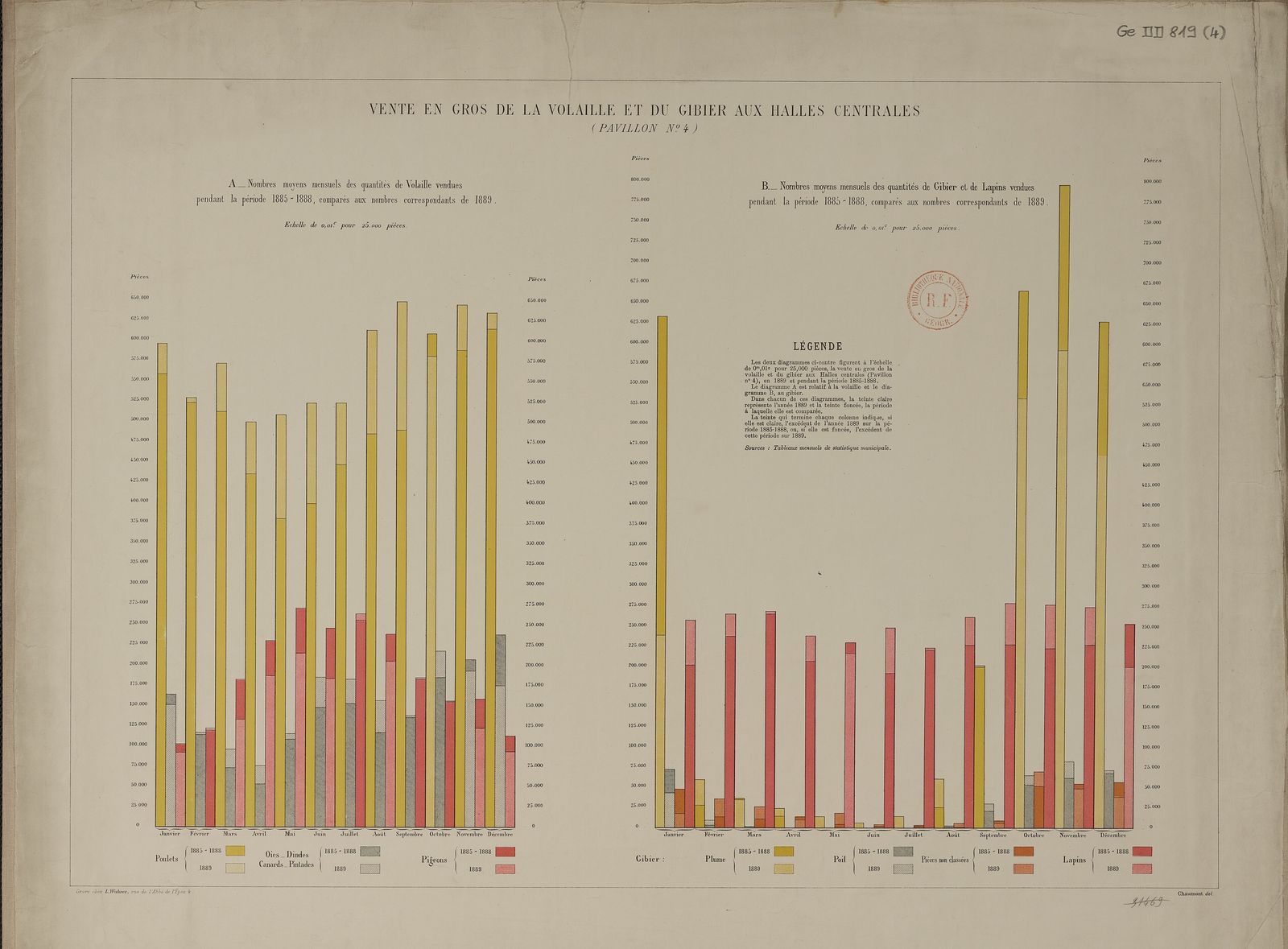
Fig. 2Detail from a chart of the average monthly wholesale of poultry and game at Les Halles, Paris, 1885 to 1888 compared with 1889.Jacques Bertillon, Album de statistique graphique, Bibliothèque nationale de France, public domain, via Wikimedia Commons.

Understanding Quantitative Research

Quantitative research answers questions about how much, how many, how often and how strongly two things move together. This note explains how concepts become variables, why design limits what you can claim, and what to check before the first test.

Read this note

N. 001

Quantitative

3 min read

  1. 002 Choosing the Right Statistical MethodThree earlier questions narrow the choice of test to one or two sensible options. Quantitative 3 min read
  2. 003 The Role of Thematic AnalysisHow codes become themes, and why a topic summary is not yet a finding. Qualitative 3 min read
  3. 004 Research Design: Where Should You Begin?A good question already hints at the design that could answer it. Research design 3 min read
  4. 005 Interpreting Statistical ResultsWhat a p-value can and cannot tell you, and how to turn output into clear sentences. Quantitative 3 min read
Wood-panelled library with tall bookshelves, a lamp and an open book on a reading stand
Fig. 3The Max Reinhardt Library, Schloss Leopoldskron, Salzburg.Photo: Jorge Royan, CC BY-SA 3.0, via Wikimedia Commons.

04About EssayMaster

Careful work, explained clearly.

EssayMaster is a research and thesis support brand for students working through complex research projects.

We believe a result is only useful when you can explain it yourself, so our support focuses on understanding why a method fits the question, what a piece of output means, and where its limits lie, while the research and its decisions remain yours.

  1. I.

    Question first

    Support begins with what you are trying to find out, not with a menu of tests.

  2. II.

    Explained in plain language

    Methods and output are turned into sentences you can repeat with confidence.

  3. III.

    Every detail matters

    Coding, tables and references receive the same care as the argument.

More about our approach

EssayMaster.

Thoughtful Research.Meaningful Results.

Research & Thesis Support